World Sexual Health Day 2026

Every person has a body. For as long as we are alive, we live in one and through it we experience intimacy, pleasure, connection, and care.

Every Body is the World Sexual Health Day 2026 theme, a declaration that Sexual Health, Rights, Justice and Pleasure belong to every person, in every body, without exception.


About World Sexual Health Day 2026


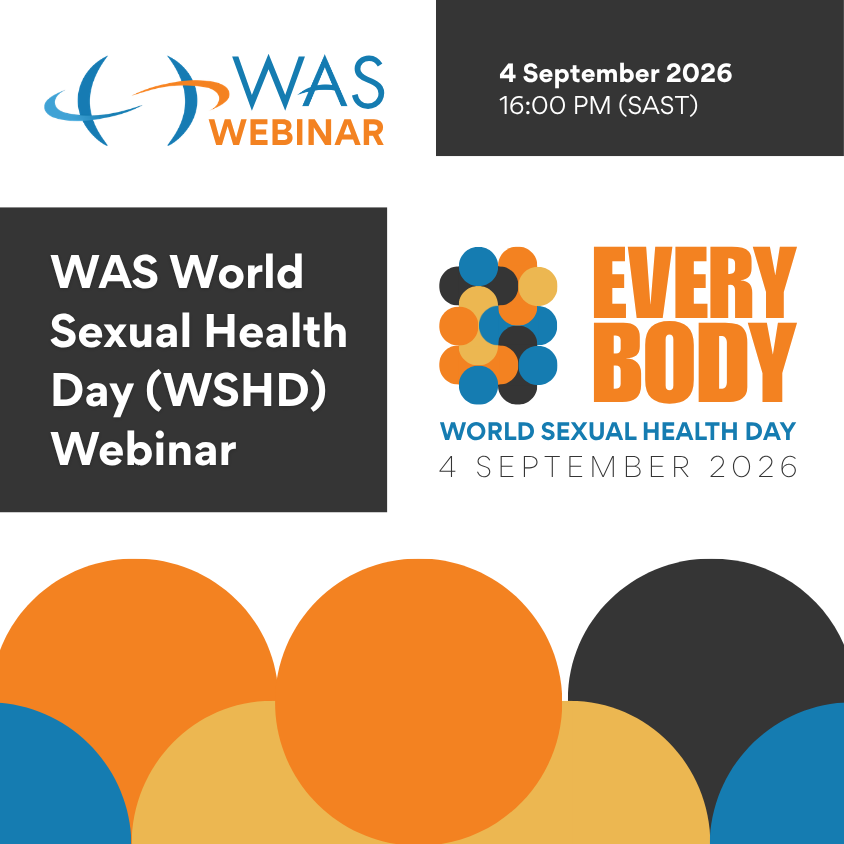
World Sexual Health Day (WSHD) is the annual global initiative of the World Association for Sexual Health (WAS). Each September 4, health professionals, advocates, educators, researchers, and communities around the world come together around a shared theme.

For 2026, that theme is Every Body.

Written as two words, the theme holds two ideas at once: every person, and the body they inhabit. Sexual health is always lived in a body — and what determines whether that body experiences care, dignity, and pleasure is not the body itself. It is the world that body moves through: the policies, the power structures, the stigma, and the assumptions embedded in the systems we all rely on.

Every Body asks us: Whose bodies are sexual health systems built for, and whose are left out?


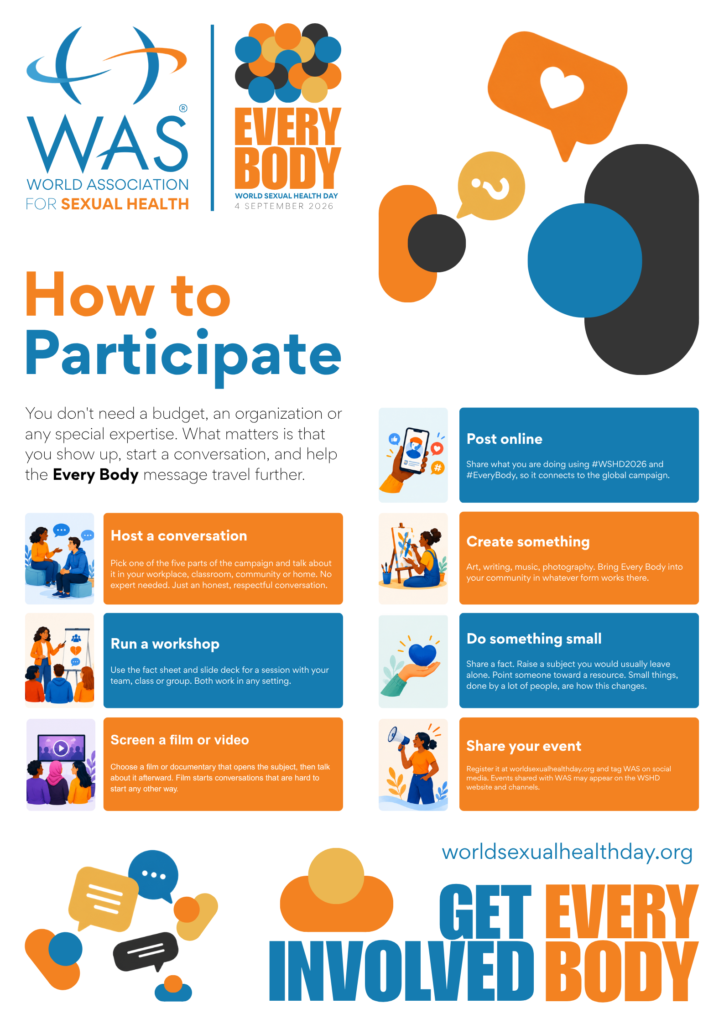
Get EVERY BODY Involved

Whose voices, bodies, and contexts are still missing from the global sexual health conversation?

World Sexual Health Day 2026 is September 4 – but the global campaign runs across the entire month, and the events that make it meaningful happen everywhere. A conference, a clinic training, a classroom session, a community radio segment, a social media thread.

It all counts. And we want to know about it.

🔵 Visibility builds the movement. Registering your activity demonstrates to funders, policymakers, media, and the next generation that this work is happening everywhere, in every kind of context, at every scale.

🔵 Counting changes what gets resourced. Sexual Health, Rights, Justice and Pleasure attract more support when we can show how much is already underway.

🔵 Connection multiplies impact. Someone in your region running a complementary event becomes a collaborator.

🔵 The Every Body theme depends on it. This year’s theme is about whose bodies are reflected in the global sexual health conversation. That question is answered by who takes part.


The Ten Themes of Every Body in 2026

  • Throughout 2026, WAS will explore ten themes – each one a lens on the structural forces that shape whether a person can access sexual health, rights, justice, and pleasure.

  • These are not descriptions of people. They are invitations to examine power, and to change it.


These themes are not exhaustive. They are a starting pointand they overlap — a person can be aging, disabled, and racialized at once, and the systems that fail them do not sort neatly into ten categories.

We welcome additional perspectives, suggestions, and voices from communities around the world.

People who live in young bodies

When age-appropriate information about bodies, boundaries, and consent is withheld from children, it is not protection. It is a gap that leaves them more vulnerable. The sexual health of young people is shaped by what they are given access to, and what is withheld.

People who live in aging bodies

Ageism embedded in health systems means older adults are routinely left out of sexual health conversations, despite desire, relationships, and intimacy continuing across the entire lifespan. Sexual well-being belongs to every stage of life.

People with disabilities

Systemic ableism means people with disabilities and neurodivergent people are routinely excluded from sexuality education and sexual healthcare, despite having the same sexual health needs, rights, and capacity for pleasure as everyone else. The gaps in provision are real, and so is the right to have them addressed.

People born with intersex variations

People born with intersex variations have natural variations in sex characteristics and are frequently subjected to medically unnecessary interventions aimed at normalization, typically in infancy, before they can speak for themselves. These variations are not something to be corrected.

People whose bodies are racialized

Structural racism determines who gets access to quality sexual healthcare, how pain is assessed and treated, and who is believed and dignified within health systems. These outcomes are not produced by biology. They are produced by power.

People who live in bodies of different sizes

Weight stigma is embedded in provider attitudes and institutional norms, and it functions as a barrier to equitable sexual healthcare. Body size does not determine whether someone deserves good care, nor should it determine the quality of care they receive.

Trans and gender-diverse people and their bodies

Transphobia at structural, interpersonal, and institutional levels means trans and gender-diverse people face significant barriers to healthcare rooted in stigma, not clinical necessity. Their right to sexual health is not contingent on the attitudes of individual providers.

People living with chronic illness and people who are dying

For people living with long-term or invisible illness, sexual health is rarely part of the clinical conversation, even when illness directly affects it. And at the end of life, intimacy and closeness remain deeply human needs that palliative care almost never addresses.

Pregnant and postpartum people

Questions about desire, comfort, body image, and intimacy are rarely raised in routine antenatal or postnatal care, leaving many people to navigate significant bodily changes without information or support.

People who live in bodies experiencing menopause and perimenopause

Menopause and perimenopause profoundly affect sexual health, yet remain among the most under-addressed topics in clinical care. Midlife and later-life transitions deserve the same quality of care and attention as any other stage of life.

WSHD 2026 Toolkit

The official World Sexual Health Day 2026 toolkit is now available, including messaging guidance, event planning resources and more.

Check back here for updates. The official WSHD Social Media Pack wil be shared soon. 

Hashtags: #WSHD2026 #EveryBody

Download Official WSHD 2026 Slide Deck

Access the WSHD 2026 Canva Slide Deck in English.

Use these as conversation starters. Ideal for peer educators, health professionals, educators, and community groups.

Download Official WSHD 2026 Film and Video Guide

Download the WSHD 2026 Film and Video Guide in English.

Use these for community screenings, workshops, classroom sessions, or self-guided viewing.

Download Official WSHD 2026 Fact Sheets

Download the WSHD 2026 Fact Sheets in English.

Want to help spread the word to EVERY BODY?

Email Lisa Welsh, to help translate these into your own language.

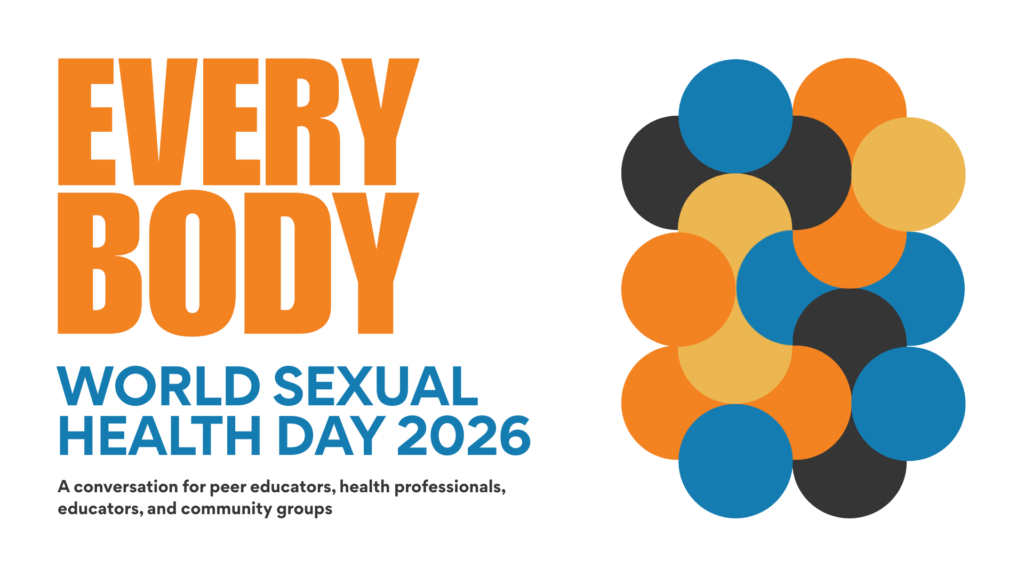
Download Official WSHD 2026 Logos


Download the WSHD 2026 logo in English.

Use them in your WSHD 2026 event promotional materials and help spread the word to EVERY BODY.


Descarga el logotipo del WSHD 2026 en español.

Úsalo en el material promocional de tu evento del WSHD 2026 y ayuda a difundir el mensaje a TODO EL MUNDO.


Descarregue o logótipo do WSHD 2026 em português.

Utilize-o no material de divulgação do seu evento WSHD 2026 e ajude a espalhar a mensagem por TODOS.

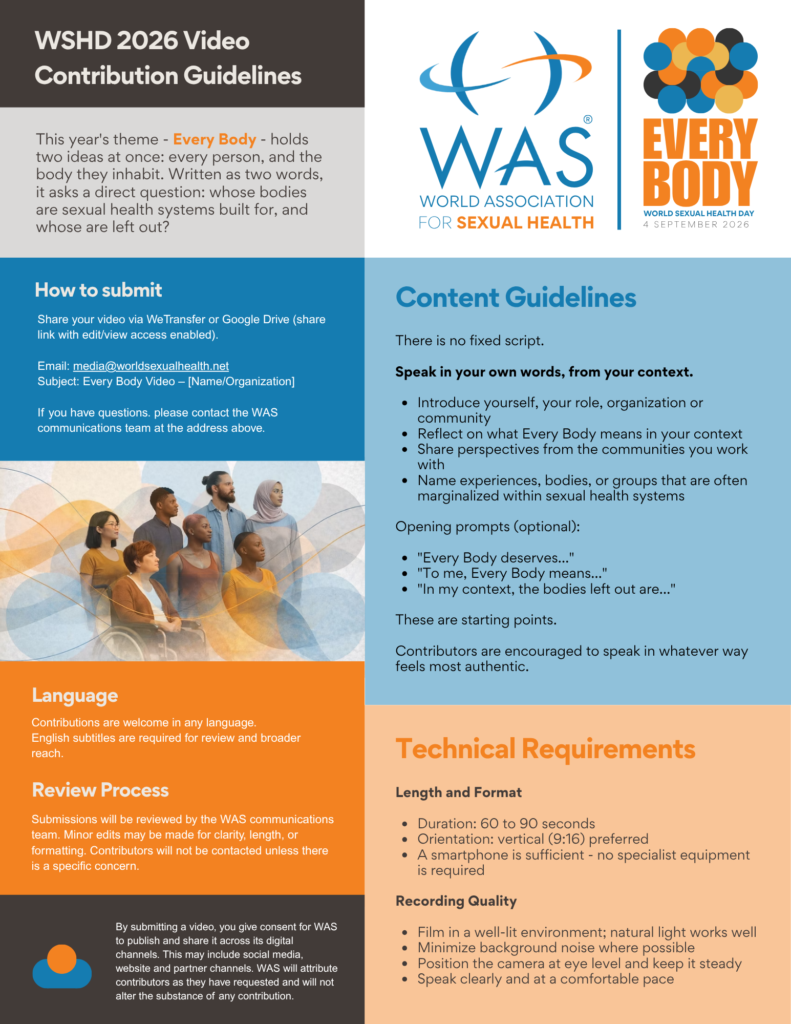
Share Your Every Body Story

We are collecting perspectives from across the global sexual health community — what Every Body means where you work, what is missing from the conversation in your context, and what you are doing about it.

To help you prepare, read the guidelines below.